In this article
The Chromosomal Countdown
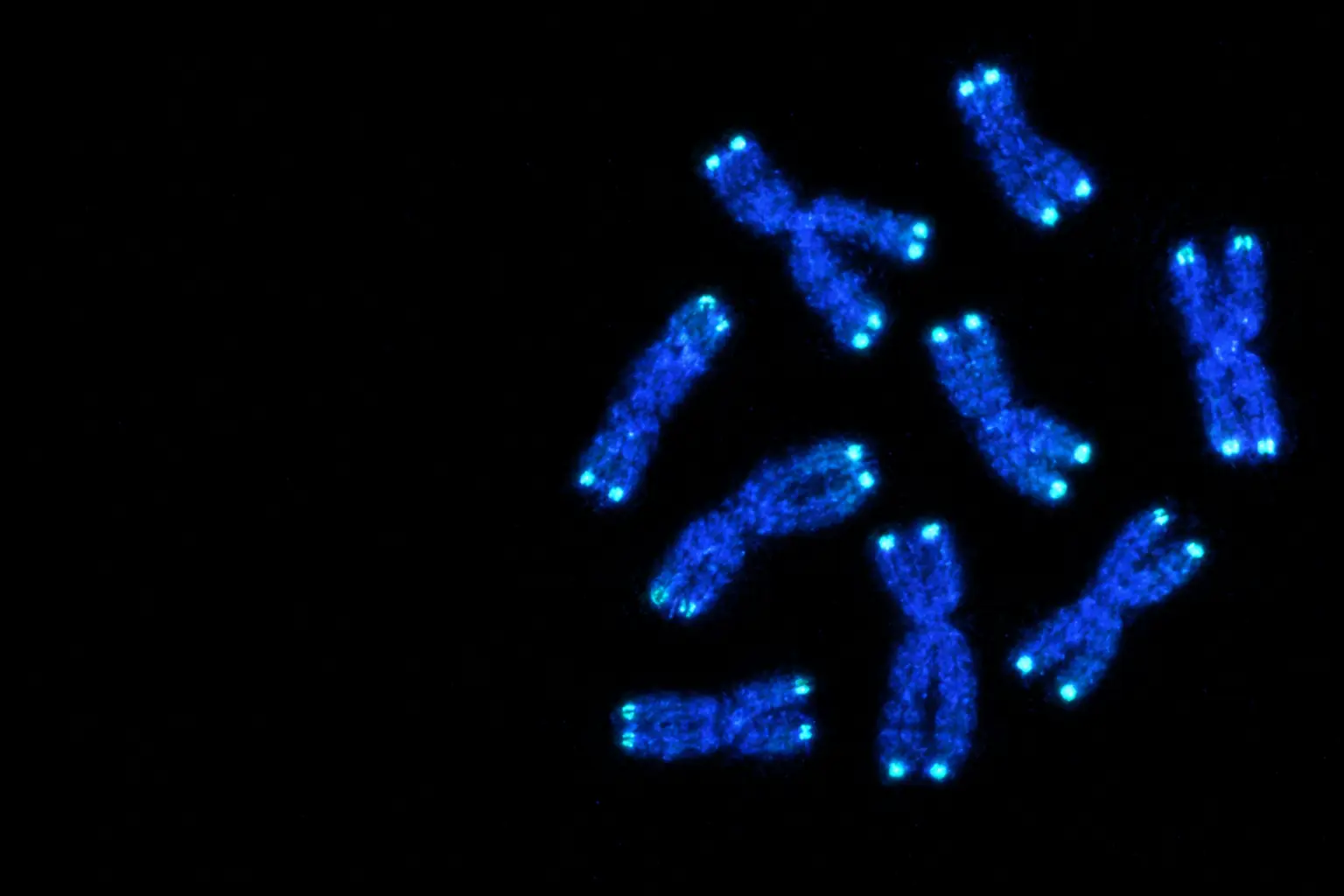
At the tip of every chromosome in your body sits a repetitive DNA sequence called a telomere. Think of it as the plastic cap on the end of a shoelace — it protects the chromosome from fraying, sticking to other chromosomes, or losing important genetic information during cell division.
Here is the catch: with each cell division, telomeres get a little shorter. They are the biological countdown clock that limits how many times a cell can divide before it enters senescence (permanent retirement) or apoptosis (programmed death). When telomeres become critically short, the cell can no longer divide safely.
Telomere Biology 101
Telomeres consist of the repeated DNA sequence TTAGGG, extending for thousands of base pairs. At birth, telomere length averages approximately 10,000-15,000 base pairs. By old age, this may decrease to 4,000-6,000 base pairs. When telomeres reach a critical minimum length, the cell triggers a DNA damage response that halts further division.
An enzyme called telomerase can add telomeric repeats back to chromosome ends, partially counteracting the shortening process. Telomerase is highly active in stem cells and reproductive cells but is largely suppressed in most adult somatic cells — which is why most of your cells have a finite replicative lifespan.
The 2009 Nobel Prize in Physiology or Medicine was awarded to Elizabeth Blackburn, Carol Greider, and Jack Szostak for their discovery of telomere biology and telomerase — underscoring the fundamental importance of this system.
What Telomere Length Tells Us
Population studies have consistently shown that shorter telomere length is associated with increased mortality, cardiovascular disease, diabetes, and certain cancers. A 2017 meta-analysis in BMJ encompassing over 120,000 participants found that individuals in the shortest telomere length quartile had a 26% higher risk of all-cause mortality compared to those in the longest quartile.
However — and this is important — telomere length is a statistical association at the population level. At the individual level, a single telomere measurement has significant variability and limited predictive power for any specific person. It is one piece of a much larger biological puzzle.
What Influences Telomere Length?
Genetics: Approximately 30-80% of telomere length variation is heritable. Some people are simply born with longer telomeres.
Chronic stress: Epel and Blackburn's pioneering research demonstrated that chronic psychological stress accelerates telomere shortening through oxidative damage and cortisol-mediated mechanisms.
Exercise: Regular physical activity is associated with longer telomeres. A 2017 study in Preventive Medicine found that adults who engaged in high levels of physical activity had telomere lengths corresponding to approximately 9 fewer years of biological aging.
Diet quality: Mediterranean-style diets, rich in antioxidants and anti-inflammatory compounds, are associated with longer telomeres. Conversely, ultra-processed food consumption correlates with shorter telomeres.
Sleep: Poor sleep quality and short sleep duration are associated with accelerated telomere attrition.
Telomeres in Context
Telomere length is a valuable biomarker when interpreted alongside other measures of biological aging — epigenetic clocks, inflammatory markers, metabolic health, and functional fitness assessments. On its own, it provides limited actionable insight. In combination with other data, it enriches the picture.
At Genoryx, we include telomere length assessment as part of our comprehensive biological age evaluation — never in isolation, always in context. Book a consultation to understand your complete biological aging profile.
Go deeper
Related explainers
Sources
Studies named in this article that we matched to the original paper. A study described without enough detail to identify it is not listed.
- 01Epel ES, Blackburn EH, Lin J, et al. Accelerated telomere shortening in response to life stress. Proceedings of the National Academy of Sciences of the United States of America. 2004. doi:10.1073/pnas.0407162101 (opens in a new tab)
- 02Tucker LA. Physical activity and telomere length in U.S. men and women: An NHANES investigation. Preventive Medicine. 2017. doi:10.1016/j.ypmed.2017.04.027 (opens in a new tab)
This article is for education. It is not a diagnosis or a treatment plan; decisions about tests, medicines or supplements belong in a consultation with a physician who knows your history.

About the author
Dr. R. Brahmananda Reddy
MSc Dermatology, University of Hertfordshire (UK) · Founder & Chief Longevity Physician
MBBS · MSc Dermatology (University of Hertfordshire, UK) · Fellowship in Aesthetic & Regenerative Medicine (University of Greifswald, Germany). 13+ years in clinical practice.
Full profile