In this article
The False Choice
For decades, the fitness industry has insisted that losing fat and gaining muscle simultaneously is impossible — that you must "bulk" or "cut" in separate phases. For younger individuals, this binary approach has some physiological logic. But after 40, the conversation changes entirely, and the conventional wisdom becomes not just incomplete but potentially counterproductive.
The reality? Body recomposition — simultaneously reducing fat mass while increasing lean muscle mass — is not only possible after 40, it may be the optimal approach for this demographic.
Why After 40 Is Different
Several age-related changes make the post-40 body composition conversation unique:
Sarcopenia: Beginning around age 30-40, you lose approximately 3-8% of muscle mass per decade, with the rate accelerating after 60. This progressive muscle loss — called sarcopenia — is one of the strongest predictors of disability, falls, metabolic dysfunction, and mortality in older adults.
Hormonal shifts: Declining testosterone (in men) and estrogen (in women), along with rising cortisol and decreasing growth hormone, create a hormonal environment that favors fat storage and muscle loss.
Metabolic adaptation: Basal metabolic rate declines with age, partly due to muscle loss itself. Less muscle means fewer calories burned at rest, creating a vicious cycle.
Given these realities, aggressive caloric restriction — the classic "cutting" approach — is particularly problematic after 40 because it accelerates muscle loss. Losing 10 kg through diet alone typically means losing 2-3 kg of muscle along with the fat. For someone already contending with sarcopenia, this is the wrong trade.
The Recomposition Strategy
Protein prioritization: Research published in the American Journal of Clinical Nutrition (2020) demonstrates that adults over 40 need more protein per meal to achieve the same muscle protein synthesis response as younger adults. The current recommendation for body recomposition after 40 is 1.6-2.2 grams of protein per kilogram of body weight per day, distributed across 3-4 meals with at least 35-40 grams per meal.
Resistance training: Progressive resistance training 3-4 times per week is non-negotiable. Focus on compound movements — squats, deadlifts, presses, rows — that recruit large muscle groups. A 2021 meta-analysis in Sports Medicine confirmed that adults over 40 who combine resistance training with adequate protein intake can simultaneously gain muscle and lose fat.
Moderate caloric deficit: Rather than aggressive restriction, aim for a deficit of only 10-20% below maintenance. This slower approach preserves muscle while allowing steady fat loss of approximately 0.25-0.5 kg per week.
Sleep and recovery: Growth hormone is primarily released during deep sleep. Poor sleep sabotages both muscle recovery and fat metabolism. Seven to nine hours of quality sleep is essential for recomposition.
Measuring Progress Correctly
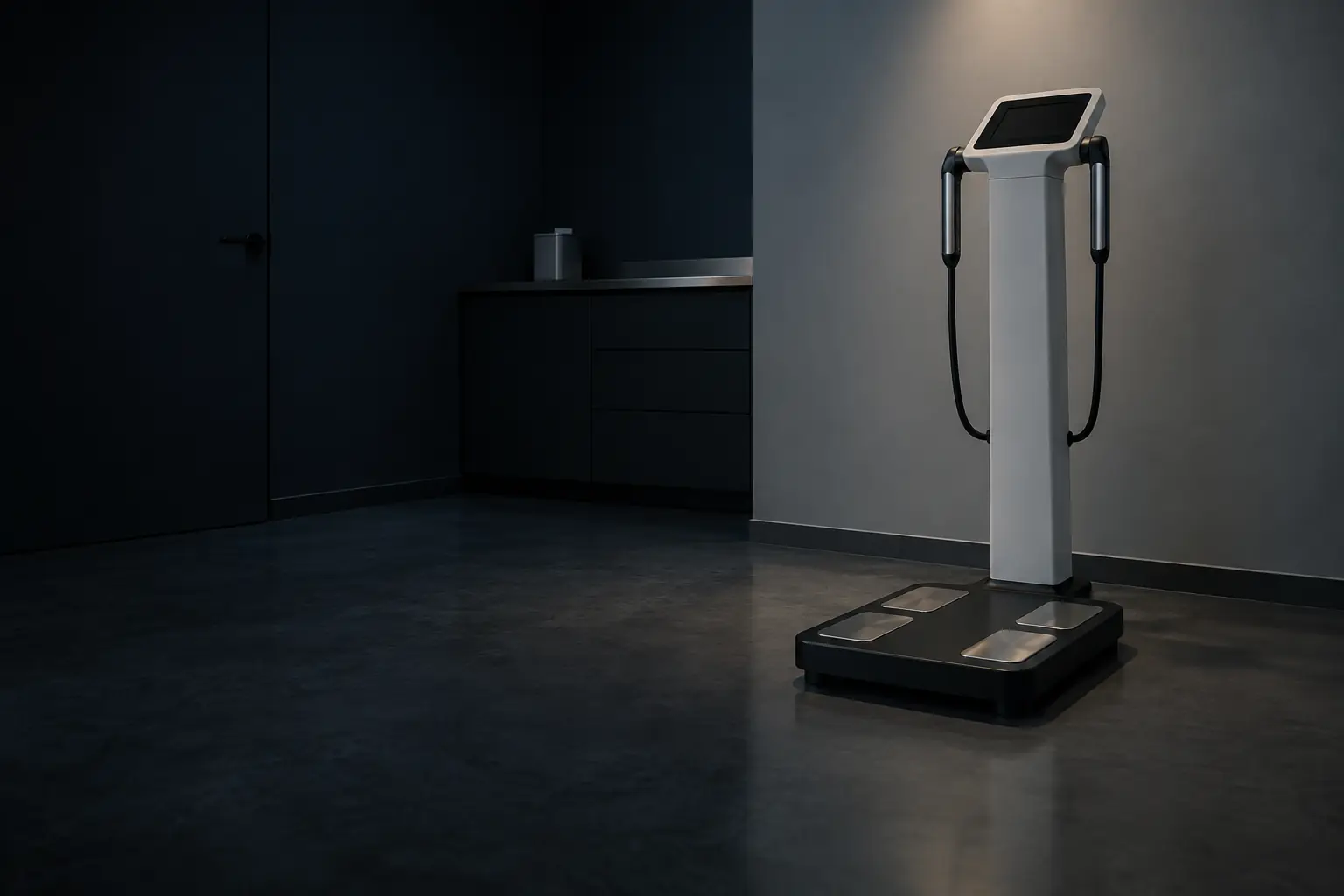
The scale is a poor tool for tracking body recomposition because your weight may not change even as your body composition improves dramatically. A DEXA scan or bioimpedance analysis provides the granularity needed to track fat mass and lean mass independently.
At Genoryx, we use DEXA body composition analysis combined with metabolic and hormonal biomarker assessment to design and track recomposition programs. Book a consultation to build a plan that respects your biology while transforming your body composition.
Sources
Studies named in this article that we matched to the original paper. A study described without enough detail to identify it is not listed.
- 01Volpi E, Nazemi R, Fujita S. Muscle tissue changes with aging. Current Opinion in Clinical Nutrition and Metabolic Care. 2004. doi:10.1097/01.mco.0000134362.76653.b2 (opens in a new tab)
This article is for education. It is not a diagnosis or a treatment plan; decisions about tests, medicines or supplements belong in a consultation with a physician who knows your history.

About the author
Dr. R. Brahmananda Reddy
MSc Dermatology, University of Hertfordshire (UK) · Founder & Chief Longevity Physician
MBBS · MSc Dermatology (University of Hertfordshire, UK) · Fellowship in Aesthetic & Regenerative Medicine (University of Greifswald, Germany). 13+ years in clinical practice.
Full profile